Musicians regularly remark that a single acoustic room can unlock phrases they never attempted in rehearsal. When an upright bassist hears immediate wood resonance beneath the bridge, or a drummer feels crisp cymbal decay without muddy slap-back echo, the entire ensemble relaxes into finer dynamic shading.
The Acoustic Accident of the Classic Jazz Cellar
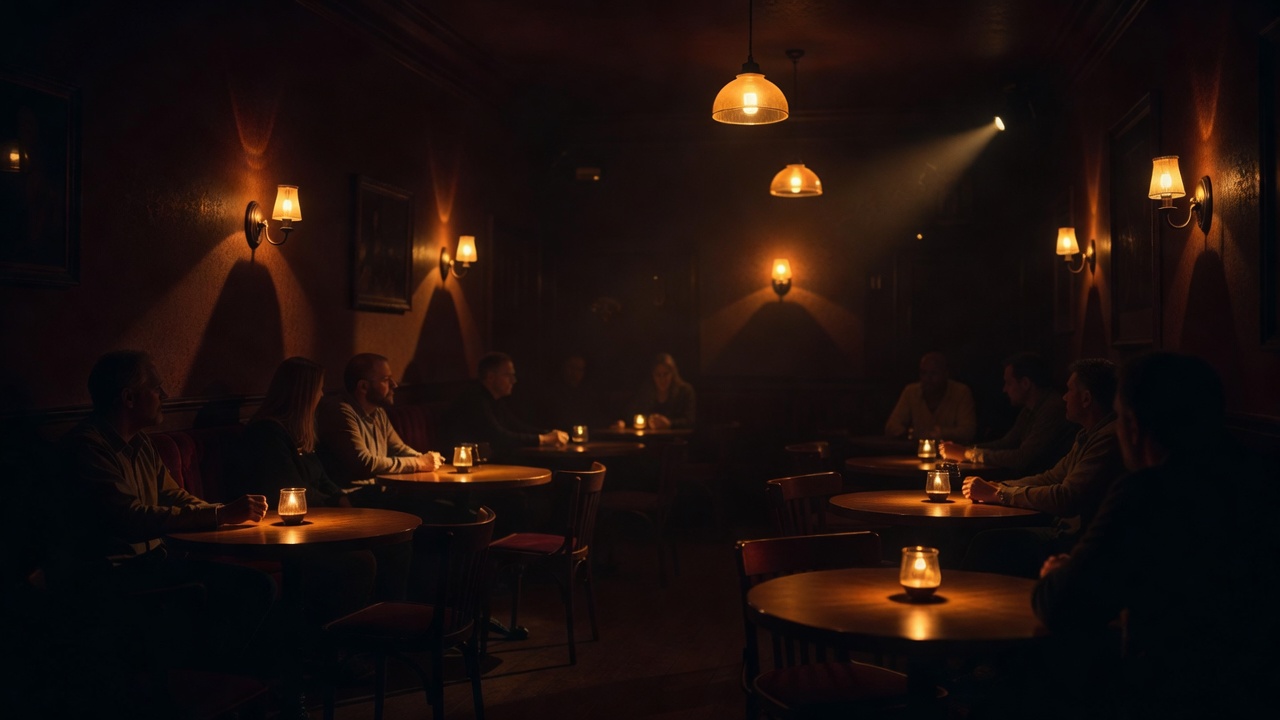
No venue illustrates the mystery of room geometry more famously than New York’s Village Vanguard, opened by Max Gordon in 1935 and shepherded for decades afterward by Lorraine Gordon. Its wedge-shaped basement floor plan—originally an accidental consequence of Greenwich Village street angles—breaks up parallel standing waves that plague rectangular clubs. Scores of landmark live recordings by Bill Evans, John Coltrane and Sonny Rollins owe their uncanny warmth to that low-ceilinged triangle, where audience murmurs sit close enough to create electricity without swallowing piano overtones.
Across the Atlantic, historic rooms along Paris’s Rue des Lombards—including Sunset-Sunside and Duc des Lombards—alongside Soho’s Ronnie Scott’s in London and Stockholm’s Fasching preserve different aspects of club intimacy. In these rooms, listeners sit close enough to watch brush strokes on a coated snare drum or read eyebrow cues between a trumpeter and pianist before an unexpected modulation. Because the distance between bandstand and back row remains short, sound engineers can keep stage reinforcement light, letting acoustic horns project naturally rather than relying on heavy public-address speakers.
Purpose-Built European Houses for Attentive Listening
Beginning in the late twentieth century, European municipalities and jazz foundations began commissioning rooms engineered explicitly for improvised music rather than adapting leftover bars or symphonic halls built for ninety-piece orchestras. Amsterdam’s Bimhuis, relocated in 2005 to a cantilevered black box overlooking the IJ waterfront, became a global benchmark. Its steep, stepped auditorium wraps listeners closely around a low bandstand while dark acoustic surfaces hold reverberation tight enough for fast bebop articulation yet warm enough for solo cello or brass chambers.
Similar acoustic discipline animates Oslo’s Victoria Nasjonal Jazzscene—housed inside a former historic cinema on Karl Johans gate—and Vienna’s Porgy & Bess, where tiered seating and balcony sightlines keep conversation separate from the listening floor. In Tampere, Finland, the brick-walled Tullikamari Pakkahuone and Klubi spaces provide a grittier industrial counterpoint during Tampere Jazz Happening, proving that adaptive reuse of freight halls can deliver remarkable clarity once bass traps and wooden risers are properly tuned. What unites these modern European houses is curatorial hospitality: clean sightlines, unhurried bar logistics during sets, and acoustic isolation from street traffic.
Heritage Theatres, Unamplified Floorboards and Tokyo’s Precision
Festivals frequently unlock heritage architecture that spends the rest of the year staging opera, chamber strings or spoken drama. During Umbria Jazz, Perugia’s eighteenth-century Teatro Morlacchi transforms afternoon piano and duo recitals into studies in velvet-draped resonance. In London, Wigmore Hall—famed for classical lieder and string quartets—offers jazz soloists an unforgivingly transparent acoustic mirror where every pedal touch and breath intake carries to the upper circle without a single microphone.
Two contrasting shrines complete the global map of jazz rooms. In New Orleans’s French Quarter, Preservation Hall (founded 1961) strips concert presentation down to bare wooden benches, plaster walls and entirely unamplified traditional brass and reed ensembles; the physical pressure of tuba and trombone fills the narrow room directly from bell to ear. Half a world away, Tokyo’s Shinjuku Pit Inn—operating since 1965—embodies Japan’s devotion to concentrated club listening, pairing disciplined room silence with meticulous stage engineering that lets experimental Japanese and visiting international players move seamlessly between whisper and roar.
How Venue Choice Reshapes Festival Programming
A perceptive artistic director never books an ensemble in the abstract; they cast a band into a specific room. Placing an acoustic oud-and-clarinet duo inside a cavernous festival tent risks losing half its colour to wind and distant crowd chatter, whereas putting a twelve-piece Afrobeat-inflected horn collective into a low wooden salon can overwhelm the walls. Whenever we report from a festival on this site, we pay close attention to that match between ensemble instrumentation and architectural envelope.